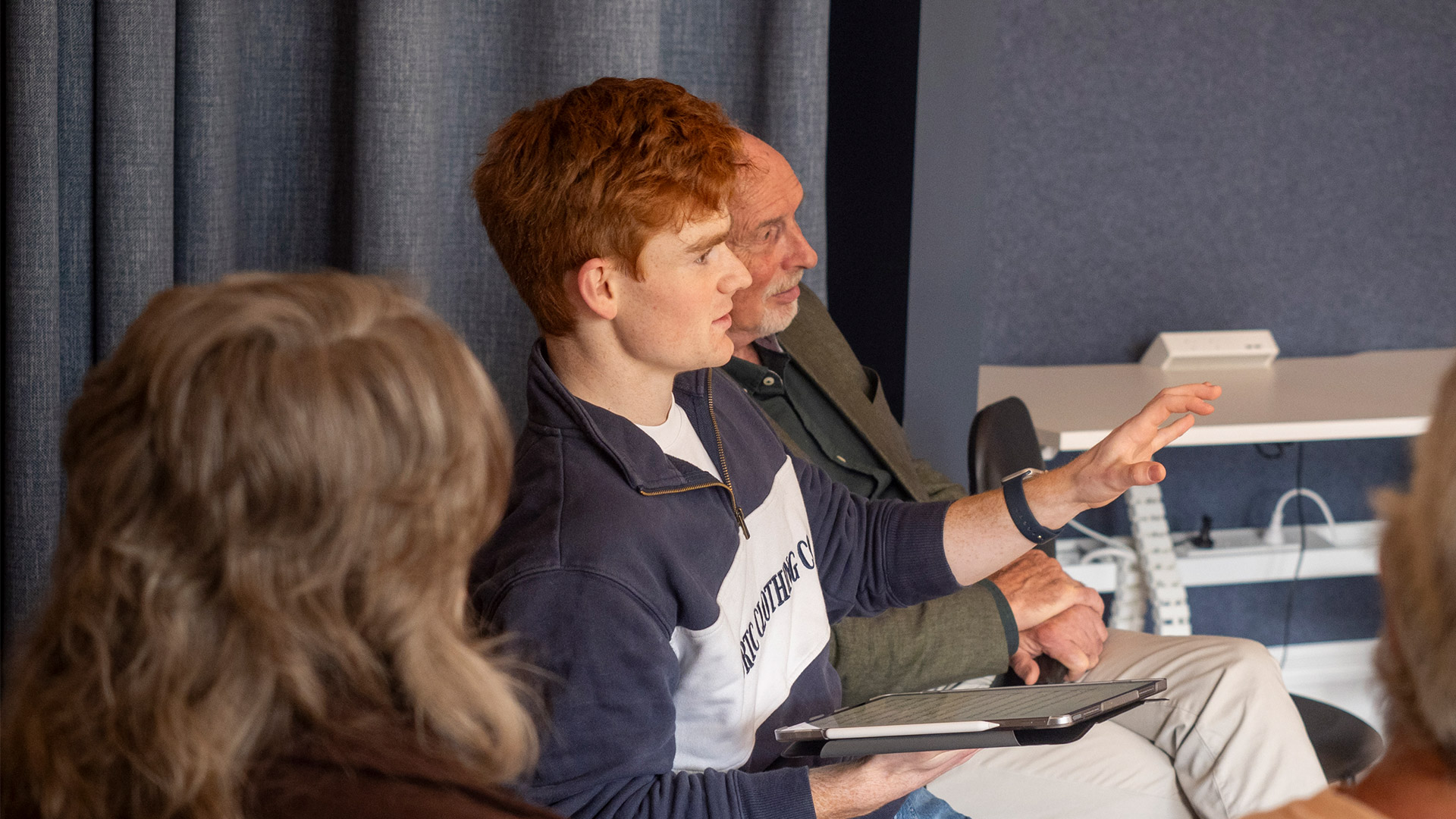
Composer Charlie Wells is a student at Adelaide University‘s Elder Conservatorium of Music and School of Performing Arts. One of the most rewarding things about our role as Quartet-in-Residence is that we provide composition students with opportunities to workshop and perform their music. On Friday 14 August we will give the World Premiere of Charlie Wells’s second string quartet, The Book of Wordless Poetry, in an Elder Hall Lunchtime Concert.
I wrote my second string quartet, The Book of Wordless Poetry, this year specifically for the ASQ as part of their Elder Hall Lunchtime Concert performance in August, and for my honours portfolio. During the creative process, I was especially fortunate to work with the quartet in an open rehearsal, where I was able to receive feedback and craft my composition into the version you will hear in the concert on Fri 14 August.
The rhythms and structures that exist in poetic forms throughout the world captivated my imagination for their musical possibilities. Each of the three movements, Haiku, Elegy, and Sonnetina, are inspired by their respective forms, with Sonnetina being a fusion of the Sonnet and the similarly-sounding Sonata form. Having set several poems to music for choirs in the past, it was quite a different challenge to base my music not on words from any particular texts but the essence of the form as a whole – hence the title denoting a ‘wordless’ book.
The first movement Haiku was the most straightforward to approach with its compact 5-7-5 pattern. It exists on the micro scale, with alternating quintuple and septuple meters, as well as on the macro scale in its ternary form where the A and B sections are subdivided into five and seven respectively.
The second movement Elegy required a different strategy with no set rhythm or structure. Between the unyielding motion of the first and last movements, Elegy invites meditative contemplation as the cello – so often an emblem of grief – takes centre stage.
The final movement Sonnetina is the most playful and spirited of the three, departing from the Shakespearean romantic connotations while insisting on the Iambic Pentameter with increasing angst. The 14-line couplet-rhyme is expressed through contrasting modal harmonies and a reimagination of the central motif from the Haiku.
Beyond the poetic inspiration, I have designed my quartet based on my learnings from my first string quartet A Spectator (2024) and many of my favourite string quartets to listen to (Debussy, Britten, Ravel, and Shostakovich spring to mind!).
I have huge gratitude towards Luke Harrald and the Australian String Quartet for granting me this opportunity and to my tutors Mark Ferguson and Steven Whittington who both mentored me through this process.
Words by Charlie Wells ©