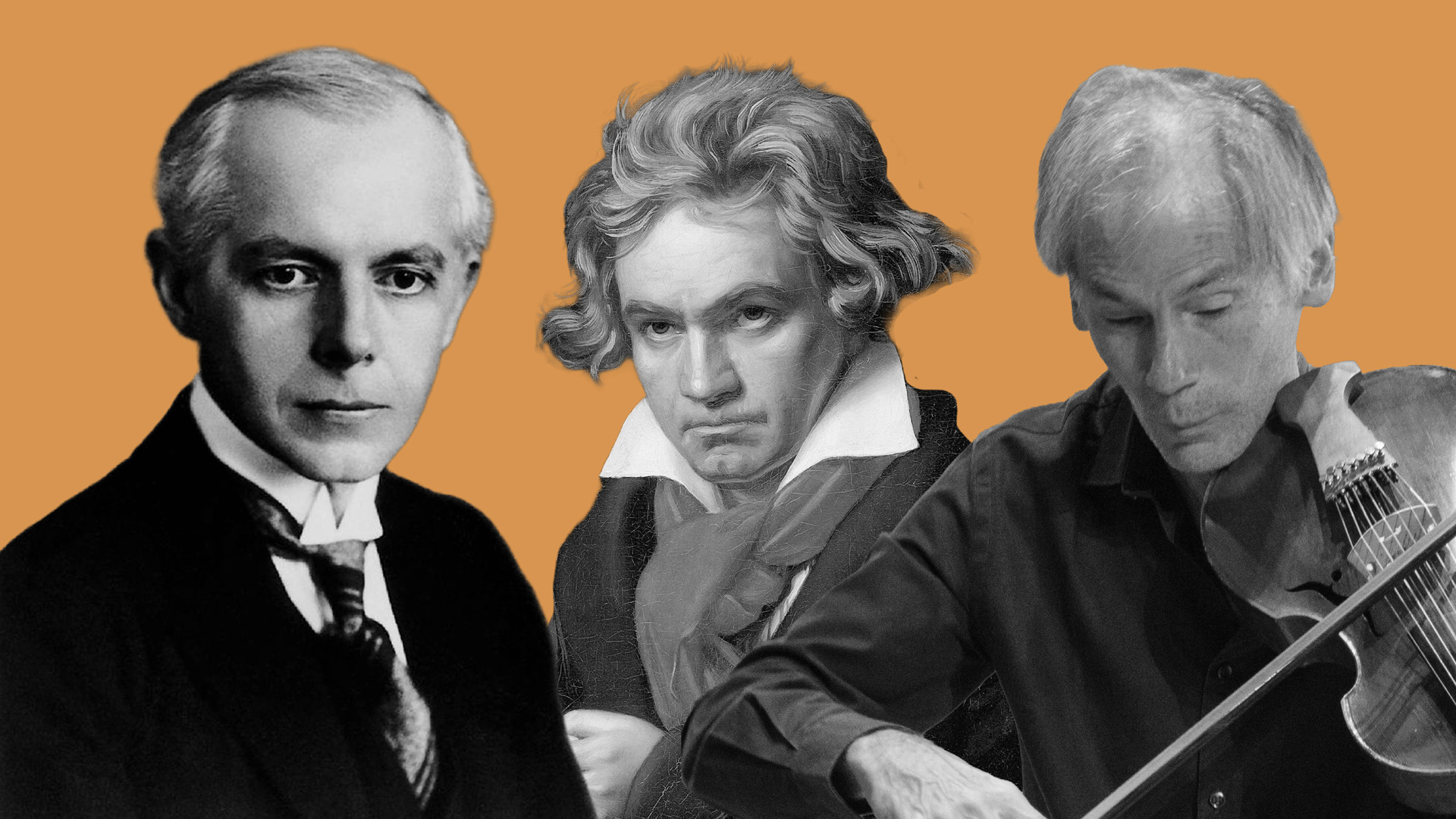
Music writer Alison Wormell explores the music of our upcoming national tour—Voyager—visiting Perth, Sydney, Mount Barker (SA), Adelaide, Canberra, Brisbane, and Melbourne between Mon 12—Thu 29 October.
As music has developed over the centuries, composers have used the string quartet to test musical limits. In this program, we see how this occurs in three different places and times as Knox, Bartók and Beethoven each take the listener on a voyage into the hitherto unknown.
Garth Knox is an Irish-born violist and composer. His music is playful and atmospheric, and often uses atypical playing techniques to express musical ideas. Knox’s work Satellites (2015) reveals his thoughts about “those things that fly around our heads and change our lives”.
Geostationary, refers to when a satellite appears to remain stationary above the Earth’s surface by moving at great speed through space. This movement drives constantly forward, as Knox creates a textured groove with overlapping parts, that never really arrives. Next is Spectral Sunrise, a dreamlike foray into the experience of seeing multiple sunrises each day on the International Space Station. It begins with trembling viola harmonics, and soon Knox expands normal-sounding string notes to include transparent string harmonics. This effect is created by lightly touching a string so that a single overtone sounds. In the last movement, Knox explores new dimensions for creating sound on string instruments. Watch the players’ bows carefully as they sound their strings from different angles or bow in unusual shapes. Even the near-silent sound of a bow whipping quickly through the air is used.
Hungarian composer Bela Bartók (1881-1945) is well known for his use of Hungarian, Romanian and Slovakian folk-music in his works. He used string quartets to expand his string textures by implementing special effects. Bartók’s Fourth String Quartet (1928) is symmetrically structured with melodic and textural similarities between linked movements.
The first movement uses Bulgarian-type irregular rhythms and explores brief melodic ideas that promote a searching feeling. Bartók contrasts savage moments with sinuous harmonics and glissandos (slides). The following movement is fleet-footed and driven, with all players muted. In the third movement, Bartók writes in the Hungarian/Romanian hore lungă (long song) style, with chordal dissonances accompanying a single melodist. To create the arc structure, the fourth movement uses themes from movement two, played pizzicato (plucked). This is an early example of Bartók’s use of the violent ‘snap’ pizzicato, now commonly known as ‘Bartók pizz’. The finale looks back to the opening movement, closing with music taken from the first movement’s end.
Ludwig van Beethoven’s (1770-1827) final four instrumental works were string quartets. Even this late in his career, he continued to hone his expressive skills, and pushed structural boundaries in these works. In fact he challenged the norm so much that the finale of his String Quartet in B-flat major Op.130 (1825) was considered too complex for performers and audiences, and was replaced, then re-published separately. The quartet’s six-movement structure where the four central movements create a miniature suite, is also unconventional.
The quartet begins with two themes at vastly different speeds. The slow introduction becomes the first theme and this juxtaposition creates a joyfully flighty atmosphere. The furtive and hurried Presto is similarly in B-flat, but uses the more sinister minor key. It swiftly progresses to the third movement, an ultimately whimsical promenade. The next of these vignette-like movements is a small set of variations in the completely eccentric and unrelated key of G major. The fifth movement is a winding, heartfelt song for the first violin, governed by the moving harmonies beneath, as much as the incalculable, yearning melodic line. In this concert, the original Grosse Fuge follows, omitting Beethoven’s replacement finale.
The Grosse Fuge sounds unlike any of Beethoven’s previous works. The main fugue theme is stated in unison at the outset, followed by three variations, each equating to one of the four inner sections of the fugue. The four central sections each develop a different “secondary” subject with this theme; a skipping rhythm, gentler running notes, a whimsical march with trills, then finally using all three alongside multiple versions of the main theme. The start of the coda takes music from the march but is far gentler in intensity, then touches momentarily on other sections of the movement, before rounding out one of the most unusual and striking works that Beethoven wrote.
© Alison Wormell 2026
Alison Wormell (they/them) is a music writer whose work focuses on demystifying classical music. Alison has written for Gramophone’s Opera Now Magazine, Southbank Sinfonia, Australian String Quartet, Lapland Chamber Orchestra, Australian Youth Orchestra, Cut Common Magazine, and Things Musicians Don’t Talk About.