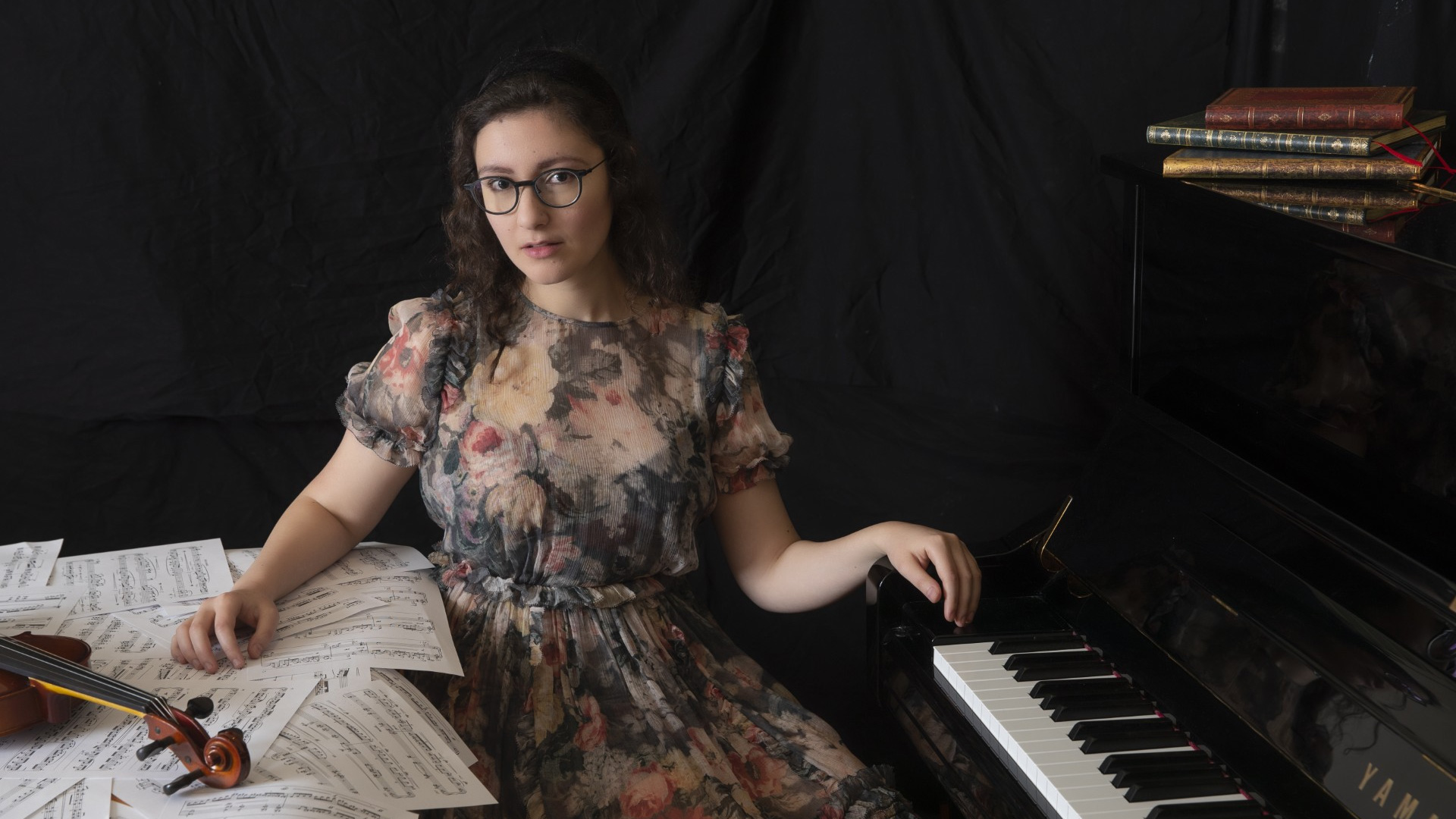
Australian composer Elizabeth Younan takes us into the world of her first string quartet, Interwoven, which features on our upcomiong national tour visiting Perth, Mount Barker (SA), Adelaide, Canberra, Sydney, Brisbane and Melbourne Mon 11—Thu 21 May.
At the heart of my compositional practice is the concept of organicism, where small musical ideas—called motives—are developed and transformed throughout the piece. A motive is a brief musical idea, like the iconic four-note phrase that opens Beethoven’s Fifth Symphony. I similarly take a simple motif and manipulate it in various ways: altering its rhythm, pitch, and instrumentation, always with purpose. Each change serves to push the music forward and maintain a sense of unity while creating contrast and excitement.
The piece begins not with the main motif but with a secondary idea introduced by the cello. This motif, characterised by a chromatic pattern (ascending semitone, descending tone), sets the stage for the harmonic and rhythmic exploration that follows. As the movement progresses, this motif gradually evolves, appearing in different voices and in slightly varied forms, creating a sense of continuity and development. The piece explores extended fugal and contrapuntal elements, before erupting into a fury of unison playing which then breaks away from each other. The second movement begins with a soulful duet between viola and cello, before expanding to the rest of the quartet. It gives way to weaving, beautiful melodic lines that communicate a yearning towards the unattainable. The third movement is effervescent and bubbly, playful, and bright, but it too is not without elements of seriousness and polyphonic play.
Throughout the entire work, elements of the motive are retained, and elements are varied; this allows the listener to simultaneously derive coherence and unity as well as musical interest and variety. Most of what I write, generally speaking, is based upon intense motivic development. In this work, these small motives undergo variation through fragmentation, stretto, transposition, retrograde, inversion, and more, which not only changes the function and roles of certain motifs to suit a range of musical contexts, but also conveys how a small amount of material can be used to generate an intriguing structure. With each technique there is purpose in its use, it is a conscious decision to communicate something to the audience–urgency, tension, suspense, surprise, excitement. In works such as this, which lack the traditional Western tonal framework, focusing upon the motive and noticing how it has been developed throughout the work is another way in which our ears will make sense of the work. Though I think you will hear that this work is not atonal, but has tonal centres, which are reinforced through the scales used, pedal points, and voice-leadings.
Ultimately, Interwoven unfolds as a dynamic and intricate journey, where even the smallest musical idea is allowed to grow, transform, and interconnect, drawing on a long tradition of motivic development—from Bach to Beethoven and beyond.
Words by Elizabeth Younan
Photo by Louie Douvie