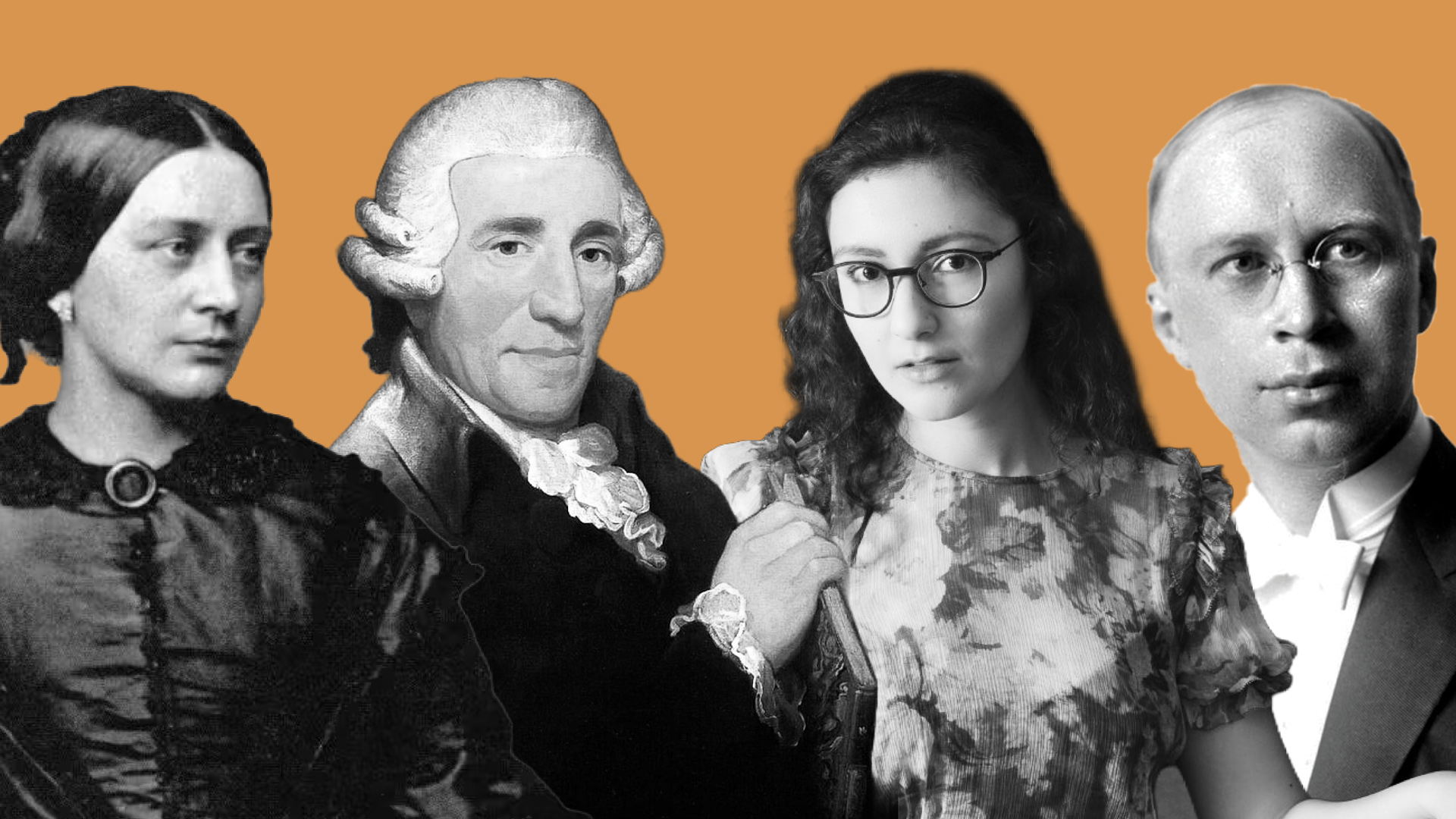
Music writer Alison Wormell explores the music of our upcoming national tour—Interwoven—visiting Perth, Mount Barker (SA), Adelaide, Canberra, Brisbane, Sydney and Melbourne Mon 11—Thu 21 May.
String quartets are an endlessly varied tapestry made of four players’ individual voices. The works in this program share common ground in musical textures and techniques, whilst showcasing four unique compositional voices placed within vastly different contexts; Australia’s Elizabeth Younan, Austria’s Franz Joseph Haydn, Russia’s Sergei Prokofiev and Germany’s Clara Schumann.
Much of Elizabeth Younan’s (b.1994) work deals with motific development, taking small ideas or ‘motifs’ and developing them across a piece. The title of Interwoven (2016-2018 rev.2019) refers to the way its motifs are tightly drawn together like threads of a fabric. This piece was started during Younan’s time in the “Composing Women” program at the Sydney Conservatorium and completed in full two years later.
Younan creates forward momentum by using her motifs in various configurations. The first movement slowly develops from the cello’s opening notes, pitting different sonic ideas against each other until the players’ energies explode together in a rush of unison notes. The following movement’s atmosphere is more suspended. Blossoming out of a duo, the entwining melodic lines evoke a sense of yearning. The closing movement is full of bubbling electricity, with abruptly changing dynamics and interlacing lines. The unsettling opening notes of the cello have transformed into something sparkling and dynamic.
Franz Joseph Haydn (1732-1809) is another composer interested in developing motifs. Each movement in his String Quartet Op.20 No.6 (1772) opens with a simple melody which he gradually ‘works out’. This particular string quartet comes from a set of six which were intrinsic to his establishment of the formal string quartet form. They are full of simple clarity, both in his ideas and the way the four parts interact satisfyingly across carefully sculpted phrases.
The first movement contains two main themes; a more effervescent initial theme and a second, melancholic one. Unusually, Haydn chooses to develop a mixture of these themes instead of choosing just one. Following this movement is an elegant promenade where the melody is repeated and embellished. The third movement is a set of dances; a simple minuet and more rustic trio, followed by the fourth movement which is an unusual fugue with three subjects (or melodies) that are imposed upon each other and developed in parallel.
In 1941, Sergei Prokofiev (1891-1953) was writing under much more stressful circumstances than Haydn. When Germany invaded the Soviet Union, artists were evacuated from Moscow and Prokofiev ended up in Nalchik, a town north of Georgia and home to many Kabardinian people. His Second String Quartet includes Kabardinian folk songs that are based around modal scales. This is a beautiful example of Prokofiev’s ‘mature’ style; full of melodic ideas, tonally loose and extremely lyrically expressive. Although he utilises many melodies, Prokofiev embraced the Soviet Union’s desire for simplicity in music as a framework to distil his musical ideas.
The first movement contains a searching duality that is both positive and somehow desperate. We are introduced to the juxtaposition of cold and warm emotions present throughout this quartet. The Adagio that follows opens with a glassy and mysterious atmosphere, supporting a high and ethereal cello melody. Whispered melodies float over running triplets before a middle section interrupts with a rustic, foot-stamping folk dance. The final movement oscillates between heavy grooves and gritty but soaring melodies over warring semiquavers, echoing textures heard in the first movement of the Younan.
The final work is Clara Schumann’s (1819-1896) Variations on a Theme by Robert Schumann Op.39 (1853), originally composed for piano and later arranged for string quartet by Éric Mouret. A renowned concert pianist and composer in her own right, Clara wrote several pieces for her husband Robert. This piece was a gift to him on his birthday. It was the result of their move to a new house where Clara had her own room for practice and composition.
The entire theme is a direct quote from Robert’s collection of piano pieces named Coloured Leaves Op.99; the seven variations, however, are entirely Clara’s work. There are sparkling moments, a funereal march, wild acrobatics and tender scenes. Variation seven recalls the Haydn second and Prokofiev third movements with a sweet melody over a bubbling obbligato line. In a full circle moment, Clara inserts a melody from the first piece she dedicated to Robert (her Op.3) into the coda that follows, connecting her music past and present.
© Alison Wormell 2026
ABOUT THE AUTHOR
Alison Wormell (they/them) is a music writer whose work focuses on demystifying classical music. Alison has written for Gramophone’s Opera Now Magazine, Southbank Sinfonia, Australian String Quartet, Lapland Chamber Orchestra, Australian Youth Orchestra, Cut Common Magazine, and Things Musicians Don’t Talk About.